

Origin and Consortium
Modular methods like 3D construction printing (3DCP) suit large-scale projects due to their adaptable approach, use of local resources, and ability to create bespoke designs, while drastically reducing waste, labour and time. 3DCP is a viable solution to address Ireland’s housing crisis and net-zero goals. To scale this technology, there is an urgent need to modernise and automate quality control and data logging in the technology. This need prompted Harcourt Technologies Ltd. (HTL) and University of Galway to develop this solution as part of the AQUA3D project.
Key Activities and Process
The project followed a systematic approach to designing an automated quality control solution for the 3DCP technology at HTL. It started with system requirements and design where the critical parameters for automated quality monitoring were defined. This was followed by data acquisition and integration where a comprehensive data capture system using depth cameras, thermal sensors, moisture analysers, and environmental sensors were combined with real-time reporting interfaces. The methodology emphasized on in-line, non contact sensing. Real-time dashboard were developed using live sensor data for reporting and logging. Thus, the project successfully combined experimental data capture, signal processing analysis, and real-time visualisation to create a scalable, intelligent, and sustainable quality control framework.

The AQUA3D collaboration with Construct Innovate has significantly enhanced HTL’s competitive position by helping us deliver automated quality control solutions that increase consistency, productivity, and reduce costs compared to traditional methodologies. This R&D has enabled us to secure new projects directly in Irish and UK markets, whilst combined with our unique seismic research integration, it has provided us with a global market advantage and is facilitating expansion into larger markets such as Southern California.
The partnership demonstrates how targeted R&D investment creates exportable IP and knowledge, establishing new business models that leverage Irish innovation expertise to compete globally. Construct Innovate’s support has been instrumental in transforming our technical capabilities into market advantages. We greatly appreciate the support and look forward to working together further and sharing in our success.

The AQUA3D project has allowed us to push the boundaries of what is possible in 3D concrete printing. By integrating advanced sensors, AI-driven analysis, and real-time monitoring into a single platform, we are transforming quality control from a manual, reactive process into an automated, predictive system.
This innovation not only enhances efficiency and sustainability but also sets a new benchmark for digital construction in Ireland and beyond.

Scale of the Challenge
The construction industry contributes over 30% of Ireland’s greenhouse gas emissions annually, with concrete alone responsible for 8% of global CO2. Traditional 3DCP quality control is manual, time-consuming, and error-prone, limiting scalability and efficiency. Ireland urgently requires faster, more sustainable building methods to meet housing demand by 2040. No single company could address this issue without cross-disciplinary expertise in automation, sensing, AI, and materials engineering.
Key Results
AQUA3D delivered a working prototype that automated data capture during 3DCP using depth cameras, thermal sensors, and ambient conditions. It reduced manual logging, improved real-time accuracy, and enabled anomaly detection in curing, extrusion, and geometry. Integration with Azure IoT Hub and Power BI provided an interactive dashboard accessible remotely. Key deliverables included the prototype system, centralised database, dashboard, protocols for realtime monitoring, and performance validation demonstrating significant reductions in errors and material wastage.

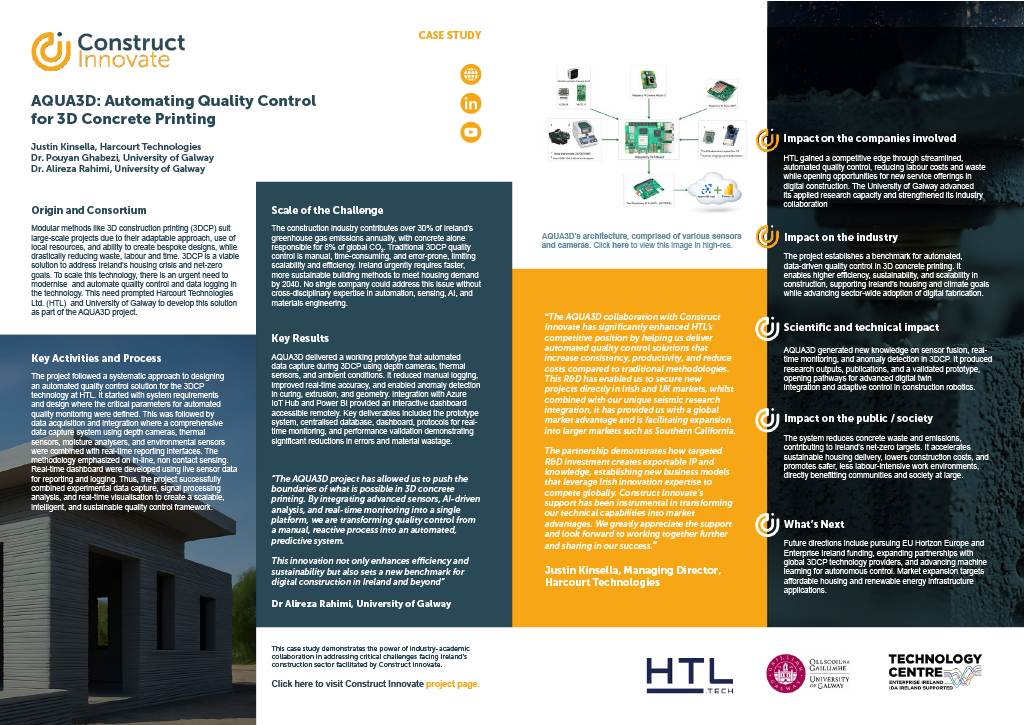
AQUA3D’s architecture, comprised of various sensors and cameras.
Collaborators


HTL gained a competitive edge through streamlined, automated quality control, reducing labour costs and waste while opening opportunities for new service offerings in digital construction. The University of Galway advanced its applied research capacity and strengthened its industry collaboration.
The project establishes a benchmark for automated, data-driven quality control in 3D concrete printing. It enables higher efficiency, sustainability, and scalability in construction, supporting Ireland’s housing and climate goals while advancing sector-wide adoption of digital fabrication.
AQUA3D generated new knowledge on sensor fusion, real-time monitoring, and anomaly detection in 3DCP. It produced research outputs, publications, and a validated prototype, opening pathways for advanced digital twin integration and adaptive control in construction robotics.
The system reduces concrete waste and emissions, contributing to Ireland’s net-zero targets. It accelerates sustainable housing delivery, lowers construction costs, and promotes safer, less labour-intensive work environments, directly benefitting communities and society at large.
Case Study
How can innovation help construction companies improve efficiency, reduce costs, and create new business opportunities?
This case study explores how Harcourt Technologies (HTL) partnered with University of Galway to develop an automated quality control system for 3D concrete printing. Discover the challenge, key project activities, and results achieved, along with the commercial benefits delivered to HTL.
Learn how the project helped HTL streamline quality control, reduce labour and material waste, strengthen its competitive position in digital construction, and create opportunities for new service offerings.

Principal Investigator

Dr Alireza Rahimi
Postdoctoral research associate at the University of Galway
Dr. Alireza Rahimi is a highly accomplished researcher specializing in sensor fusion, composite structures, and additive manufacturing. With a Ph.D. in Mechanical Engineering, his work focuses on cutting-edge advancements in robotics, sensor fusion, nanocomposite materials, and deep learning applications in engineering. Currently, as a Postdoctoral Research Associate at the University of Galway since January 2025, Dr. Rahimi leads the development of automated quality control systems for 3D concrete printing (3DCP). His work involves designing sensor networks, integrating real-time data analytics, and collaborating with industry partners to drive sustainable, efficient construction practices. His focus is on reducing waste, optimizing material use, and advancing Industry 4.0 innovations in additive manufacturing.

Dr. Pouyan Ghabezi
Assistant Professor – Lecturer above the bar at University of Galway
Experienced Researcher with a demonstrated history of working in the higher education and industry. Skilled in composite materials, Material characterization, additive manufacturing, 3D printing technology, and FEM modeling. Strong research professional with a Doctor of Philosophy – PhD focused in composite material from University of Tehran.
Podcast episode
Related content