

Summary
3D concrete printing is an innovative construction technique that “prints” structures layer-by-layer, similar to a giant office printer. While this method is fast and reduces waste, the layered process can sometimes lead to weaker buildings because the individual layers don’t always bond perfectly. To solve this, researchers at University College Dublin and Harcourt Technologies investigated adding tiny polypropylene (PP) fibres to the concrete mix to act as reinforcement.
The project found that these tiny fibres, tested in 6 mm and 12 mm lengths, significantly improve how the concrete behaves both during and after printing. During the printing phase, the fibres help the wet concrete stay stiff enough to hold its shape after being squeezed out of the nozzle while still allowing it to flow smoothly through the pipes. Once the concrete has hardened, these fibres act like tiny bridges across microscopic cracks, making the final structure much tougher and more durable.
Tests revealed that short fibres (6 mm) are particularly good at making the concrete resistant to bending, while long fibres (12 mm) are better at supporting heavy weights and helping the material “recover” its strength quickly after it has been moved by the printer. When the researchers printed actual test walls with an optimized mix, they found that the 3D-printed versions were actually stronger than traditional cast concrete. By finding this “perfect recipe,” this research helps the Irish construction industry adopt 3D printing more reliably, potentially leading to faster, more affordable, and sustainable homes in the future.

This UCD collaboration, supported by Construct Innovate, has been transformative in validating fibre-optimized mixes that significantly enhance 3D printed concrete performance. These breakthrough results not only strengthen HTL’s market leadership in sustainable housing solutions across Ireland and the UK, but are creating exportable IP and technical expertise that positions us competitively in global markets.
The research is accelerating our ability to deploy advanced concrete printing methodologies worldwide, establishing new business models that leverage Irish innovation expertise to secure projects and partnerships beyond traditional geographic boundaries. This R&D investment demonstrates how targeted academic-industry collaboration creates tangible competitive advantages that drive both local impact and international expansion opportunities.

Optimizing fibre-reinforced 3D concrete printing requires both deep research and industry validation. Construct Innovate funding enabled us to bridge that gap, taking laboratory insights into real-world trials. This project is vital in advancing sustainable digital construction for Ireland’s climate and housing goals.

Watch 90 seconds video to learn how this project was executed.
Scale of the Challenge
The Irish construction sector faces high housing demand, labour shortages, and the urgent need to reduce carbon emissions by 51% by 2030. Traditional methods are slow, resource-intensive, and wasteful, with formwork accounting for up to 40% of costs and significant CO2 from cement use. Existing single-organisation approaches could not optimise fibre dosage and mix design for 3DCP, highlighting the need for collaborative, systematic research between academia and industry.
Key Results
The project identified optimal fibre dosages by using a normalisation framework that combined rheological and mechanical performance. Radar charts were created for overall performance by evaluating positive parameters (yield stress, re-flocculation, viscosity recovery, compressive and flexural strengths) and inverted negative indicators (plastic viscosity, structuration rate, flow index). The results showed that 6 mm fibres achieved an optimal balance at 0.25%, while 12 mm fibres demonstrated consistent improvements across a broader range, with 0.20% offering the best compromise. Further, validations through 3D printing confirmed improved buildability, interlayer bonding, and reliability of fibre-optimised mixes.

3DCP process overview.
Project Partners


HTL gained a validated PP fibre mix for 3DCP, strengthening its position as Ireland’s leader in digital construction and opening pathways for new products and market opportunities.
UCD advanced its expertise in 3DCP materials research, producing high-impact publications and strengthening industry collaborations, while creating a foundation for follow-on funding in sustainable construction.
Optimised PP fibre mixes reduce cement demand, material waste, and energy use, lowering embodied carbon in construction. Economically, they enhance productivity, cut costs linked to formwork, and support industry competitiveness by accelerating adoption of digital construction methods in Ireland.
The project generated new knowledge on fibre optimization for 3DCP, resulting in a systematic framework for mix evaluation and normalisation. Peer-reviewed publications and conference outputs have advanced UCD’s leadership in digital concrete materials and set benchmarks for future research directions.
By enabling reliable and sustainable 3DCP, the project supports Ireland’s Housing for All strategy and climate targets. Fibre-optimized mixes contribute to affordable housing delivery, reduce reliance on manual labour, and promote safer, faster, and more sustainable construction practices nationally.
Case Study
How can innovation help bring emerging construction technologies closer to real-world adoption?
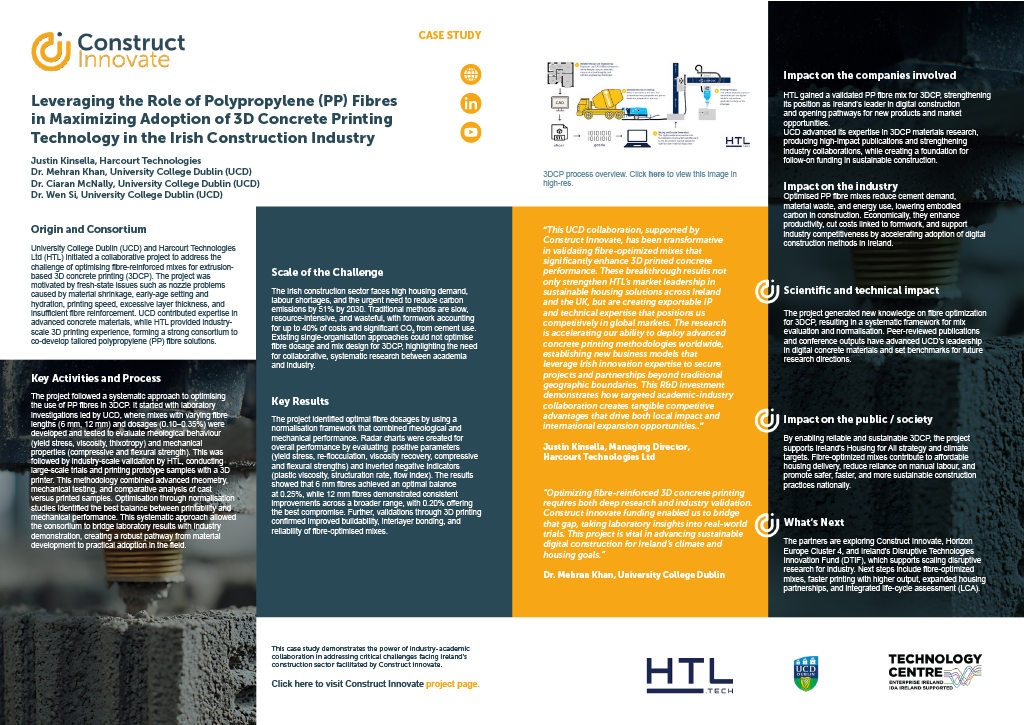
This case study explores how Harcourt Technologies (HTL) and University College Dublin (UCD) worked together to improve the performance and reliability of 3D concrete printing through advanced material innovation. Discover the challenge, key project activities, and results achieved, along with the impact on HTL’s business and future growth opportunities.
You’ll also learn how the project helped validate new 3D printing solutions, strengthen HTL’s position in digital construction, and contribute to the wider adoption of faster, more sustainable construction methods.

Principal Investigators

Dr. Mehran Khan
Assistant Professor at University College Dublin
Dr. Mehran Khan is currently an Assistant Professor at University College Dublin, Ireland. His research focuses on sustainable construction materials, including 3D-printed concrete, low-carbon concrete, fiber reinforced concrete and its mechanical performance, fracture characteristics, durability, fire resistance, cracking behavior, and compressive modeling of hybrid fiber-reinforced concrete. He serves as Principal Investigator (PI) on multiple academic and industry projects related to sustainable construction. He holds various editorial roles, including Associate Editor, Guest Editor, and Editorial Board Member of several SCI journals. Additionally, he has participated in international conferences as a Speaker and Technical Committee Member.

Dr. Ciaran McNally
Associate Professor at University College Dublin
Dr Ciaran McNally is a civil engineer and obtained his PhD in 2001 for his work on alkali aggregate reaction in Irish concretes. Subsequent to that he joined the Centre for Materials and Manufacturing in UCD, where he worked as a research engineer, covering materials research, product development, process certification and technology transfer to industry. He is currently a lecturer in the School of Civil Engineering and in 2015 obtained a Professional Diploma in Teaching and Learning. To date Dr McNally has won over 2 million Euro in research funding. He has coordinated both European and national projects, including the 3.2 million Euro Marie Curie Initial Training Network TEAM (grant no 238648). His research covers a wide array of materials, including concrete, asphalt and FRP. In recent years he has extended this to include digital design and optimisation. To date, he has published over 100 peer reviewed papers.

Dr. Wen Si
Postdoctoral Research Fellow at University College Dublin
Dr. Wen Si is a Postdoctoral Research Fellow at University College Dublin, working within Assoc Prof. Ciaran McNally’s research team. Her research focuses on advancing 3D concrete printing by incorporating various fibres to improve printability and structural integrity, supporting the adoption of this technology in the Irish construction industry. She completed her PhD in Materials Science at Dalian University of Technology in 2023, investigating the properties and microstructure of fibre-reinforced cementitious composites. In 2024, she held a research position at RMIT University, Australia, where she explored design optimization and modelling for high-performance 3D-printed concrete. Dr. Wen’s expertise spans rheology, fibre-reinforced composites and the integration of digital construction methods with advanced, low carbon material systems. She has contributed to several international research projects funded by the National Natural Science Foundation of China and has published in leading journals such as Cement and Concrete Composites, Construction and Building Materials and Nature Communications. Her work combines materials innovation with process optimization, including rheological evaluation, fibre alignment analysis and microstructural characterization, to develop resilient and environmentally sustainable 3D printable construction materials.
Related content