

Summary
This report details a nine month research project aimed at making indoor spaces, like modern offices and classrooms, sound better.
Many modern buildings use large glass windows and flat, hard walls. While these look great, they cause a major acoustic problem: sound bounces off them like a ball hitting a mirror. This creates echoes and a noisy environment where it is hard to hear people speaking clearly, leading to stress and poor concentration.
The researchers looked at a special type of 3D printed geometry called Triply Periodic Minimal Surfaces (TPMS). Think of these as incredibly complex, wavy, and organic patterns that look like something found in nature or a piece of modern art.
Instead of soaking up sound like a soft sponge (which can make a room feel dead), these 3D shapes work by breaking sound apart and scattering it in many different directions. This removes the annoying echoes while keeping the room feeling alive and natural.
This technology allows us to move away from boring, grey acoustic foam and instead use beautiful, sculptural panels that serve a dual purpose: they act as art and as a high tech tool to make rooms quieter and more comfortable.
In the future, you might see these patterns used as decorative office dividers or integrated into the walls of historic buildings and museums. The goal is to create indoor environments where it is easier to talk, focus, and work without the constant distraction of background noise.

“Amplitude is proud to sponsor this Construct Innovate project on Acoustic Metamaterials. Collaborating with leading university researchers gives us direct access to cutting-edge science, accelerating the translation of acoustic metamaterials research into real-world solutions.
This partnership allows us to combine academic insight with industry expertise, fostering innovation that can deliver measurable improvements in acoustic performance, sustainability, and design flexibility. By working together, we not only strengthen Ireland’s innovation ecosystem but also position ourselves at the forefront of pioneering technologies with the potential to transform construction and engineering practices.”

“The research opportunities this project opens up are truly exciting, allowing exploration of innovative acoustic metamaterials and cutting-edge experimental methods. The Seed Fund was fantastic in enabling this collaboration, providing the support needed to bring together expertise from multiple institutions and industry.”

“This Construct Innovate funded unique project represents a pioneering joint-venture between leading acoustic and metamaterial researchers from academia and industry. We are conducting groundbreaking research on the emerging field of acoustic metamaterials to achieve breakthrough noise control solutions and reduce environmental noise pollution.
The findings from this project are now being actively leveraged to develop functional acoustic metamaterial prototypes, establish state-of-the-art experimental testing facilities, and secure largescale research grants for further development.”

Project team:
Dr. Muhammad Gulzari, University College Dublin
Dr. Eoin King, University of Galway
Dr. David Ramirez Solana, University of Coimbra, Portugal
Dr. Emmet English, Amplitude Acoustics
Scale of the Challenge
While specific quantitative data isn’t provided, the scale is demonstrated by widespread public anger over increasing nighttime airport flights, onshore wind turbine noise, and pervasive urban traffic noise. This challenge affects Ireland nationally by harming public health, social well-being, and the economy. Existing solutions fail because the problem’s complexity requires a multi-disciplinary approach, combining expertise in environmental noise, acoustics, planning, sustainability, and acoustic metamaterials that no single organization possesses.





The industry partner, Amplitude Acoustics is gaining a new product line in acoustic metamaterial absorbers, aiming to enhance its commercial offerings and services. The academic partners (UCD and University of Galway) bolstered their research profiles and reputations through high-impact publications and advanced fundamental knowledge in the field.
This project advances the acoustic materials sector by delivering validated, optimised acoustic metamaterials, moving beyond the traditional noise insulation materials to effectively control problematic low-frequency noise in the built environment.
The project generated new knowledge in modelling and optimising acoustic metamaterials, resulting in four high impact publications and establishing a research direction for using advanced structures like Triply Periodic Minimal Surfaces for broadband noise control.
This project delivered a significant milestone towards the development of acoustic metamaterials absorbers for low frequency noise control in the built environment, directly addressing a major urban health issue, offering innovative solutions to reduce noise pollution and its associated psychological and physical detriments, thereby improving overall quality of life.
Case Study
How can research and innovation help your business develop new products and strengthen its market position?
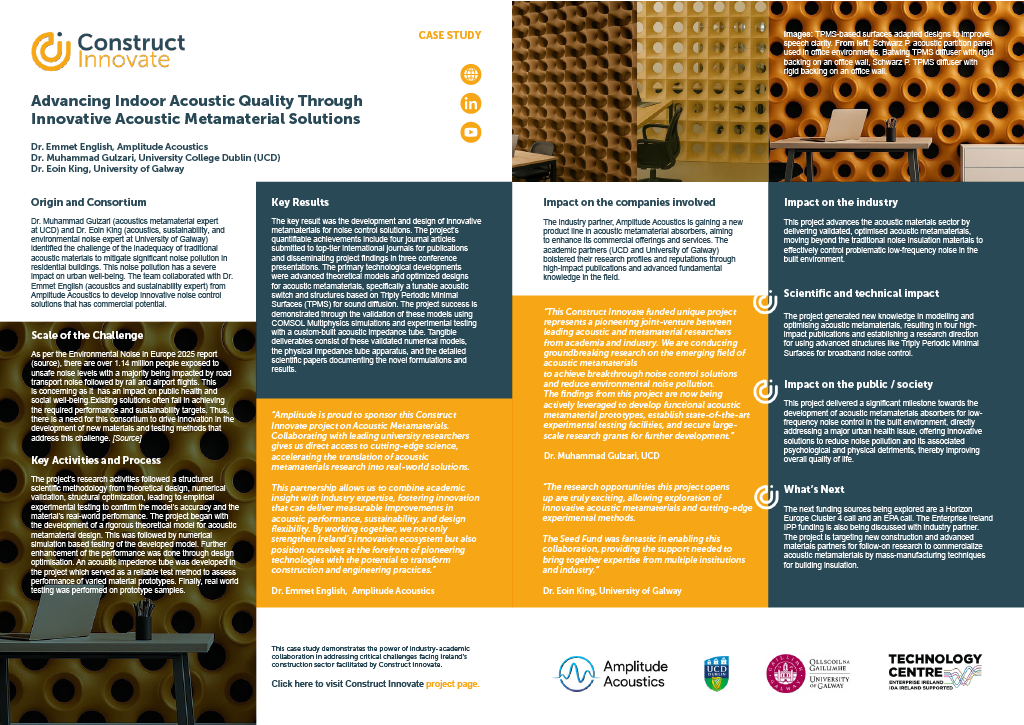
This case study explores how Amplitude Acoustics, in collaboration with University College Dublin and University of Galway, developed innovative 3D-printed acoustic solutions designed to improve speech clarity and reduce unwanted noise in modern buildings.
Discover the industry challenge, key project activities, results achieved, and the commercial impact for Amplitude Acoustics, including the development of a potential new product line and opportunities to expand its market offering.

Principal Investigators

Dr. Muhammad Gulzari
Assistant Professor, University College Dublin
Dr. Muhammad Gulzari is assistant professor at the School of Civil Engineering, University College Dublin. His research deals with mechanics and physics of artificially engineered structured materials for wave manipulation such as acoustic metamaterials and mechanical metamaterials.

Dr. Eoin King
University of Galway
Dr. Eoin King is Lecturer at the Department of Mechanical Engineering, University of Galway. He is the head of Galway Sound Lab and his research looks into the environmental acoustics, sustainability and built environment.

Dr. Emmet English
Director, Amplitude Acoustics
Dr. Emmet English is director of Amplitude Acoustics that offers a full suite of acoustic consulting services for a range of sectors and stages of project delivery, including building acoustic design, sound testing, transport, and environmental noise.
Podcast episode
Related content